Showing posts with label notes in the margin. Show all posts

1.30.2012

Notes in the Margin 1.29.12

Since the start of the new year, Deric has been walking the students through the 'main points' of Christianity. There's a lot of basics that really aren't very basic or simple to explain to someone else, especially if you don't understand them yourself. So he's been slowly reintroducing these concepts to the kids with equal emphasis on the 'why' of salvation, for example, and the 'what'. Why do we need to be saved? Who does the saving? What are we saved from?


Yesterday we looked at Genesis 3, the chapter entitled "The Fall of Man". I'm pretty sure everyone knows the story. Adam and Eve are living it up in the Garden of Eden. Everything is literally perfect. They only have one rule: "You must not eat from the tree of the knowledge of good and evil, for when you eat of it  you will surely die." (Gen. 2:17) One day, the serpent approaches Eve and asks her what God told her about that tree. Basically, the serpent convinces her she'll be fine if she eats from the tree-- actually, she'll be more than fine. She'll "be like God, knowing good and evil." (3:5) Eve looks at the tree, takes some fruit, and eats it. She hands it to her husband, and he eats it. Then they both realize they're naked, sew clothes from fig leaves, and hide from God because they're embarrassed by their nakedness. God knows what they've done, and he pronounces a curse on Adam, Eve, and the serpent. Now that Adam knows good and evil, God banishes him and Eve from the garden so that he will not also eat from the tree of life and live forever.

I didn't expect to learn anything new from this story because I've heard it so many times. But I did. And what I learned made me ask some questions that I'd never thought of before.

1. Eve changes what God said.
Satan asked Eve if God really said she couldn't eat from any tree in the garden.
Eve: "We may eat fruit from the trees in the garden, but God did say, 'You must not eat fruit from the tree that is in the middle of the garden, and you must not touch it, or you will die.'" (3:2-3)

God's commandment to Adam: "..You are free to eat from any tree in the garden; but you must not eat from the tree of the knowledge of good and evil, for when you eat of it you will surely die." (2:17)

God says that they will die if they eat from the tree.
Eve says they will die if they touch the tree.

Why did Eve change what God said? Did she just forget? Or did she change it on purpose? Did she make God sound more harsh than He really was? Do I make God sound more harsh than He really is so that I can rationalize my sin? If I make God sound more mean than He is, is it easier for me to say "that's not fair, so its okay to do such-and-such"?


2. Satan knows God's word (better than we do, I bet). He takes truth and twists it. Its much sneakier that way.

3. After talking with the serpent, Eve "saw that the fruit of the tree was good for food and pleasing to the eye, and also desirable for gaining wisdom, she took some and ate it."(3:6) Basically, Eve noticed all the good qualities of the tree.

Did she, again, forget what God said-- that she could die? Did she consciously take notice of the good qualities and consciously forget about the bad? Do I purposefully look at the 'good' that can come of sin--the pleasure, the fun, the control over my own life? Do I do this to (again) rationalize my sin?


4. Why was the tree even in the garden in the first place?
The only reason I can think is because God gave Adam and Eve a choice. They could choose to love God and follow Him, or they could choose not to follow.

Did God put the tree in the garden so that his creation could have free will?

5. God isn't mentioned during Eve's conversation with the serpent. I assume He knew it was taking place because God is omniscient.

Was His choice to stay out of the conversation part of His desire to give Adam and Eve a choice? Could God have stepped in and prevented Eve from taking the fruit? Probably. But did He allow her to make her own choice? I think so. 

6. After all was said and done, "God made garments of skin for Adam and his wife and clothed them." (3:21)
Up to this point in Genesis, there is no mention of death. Adam and Eve were vegetarians: "Then God said, I give you every seed-bearing plant on the face of the whole earth and every tree that has fruit with seed in it. They will be yours for food." (1:29) Even the animals were vegetarians: "And to all the beasts of the earth and all the birds of the air and all the creatures that move on the ground--everything that has the breath of life in it--I give every green plant for food." (v. 30)

To make a garment of skin, an animal has to be killed. Adam's and Eve's sin brought about death. An animal died so that their shame in being naked could be covered.

But of course, this story isn't over. Our choices to go against God are sinful. Sin leads to death. But God loves us even when we choose not to love Him, and He graciously provided us a second chance through Jesus. Thank the Lord! (Seriously.)

Photobucket

11.06.2011

Notes in the Margin 11.6.11

"Blessed are the merciful, for they will be shown mercy." Matthew 5:7


In the well-known story of the good Samaritan (Luke 10:25-37), we're shown three components of mercy.

1. See the need.

"A priest...saw the man and passed by on the other side."
"A Levite, when he came to the place and saw him, passed by on the other side."
"A Samaritan, as he traveled, came where the man was; and when he saw him..."

2. Feel compassion.

"...when [the Samaritan] saw him, he took pity on him".

3. Act.

"He went to him and bandaged his wounds, pouring on oil and wine. Then he put the man on his own donkey, took him to an inn and took care of him. The next day he took out two silver coins and gave them to the innkeeper. 'Look after him', he said, 'and when I return, I will reimburse you for any extra expense you may have.'" (10:34-35)

Two of the three men in this story saw the need and do nothing about it. They didn't even feel anything when they saw him (that we know of). Both of those men were religious men: one was a priest, and one was a Levite. You'd think they would have been the one to take care of the beaten man, but they ignored him and went on their way. I've heard two morals to this story. First, compassion by itself doesn't help anyone. Compassion should lead to action. Second, its easy to get distracted by 'ministry' (and all the programs that go with it) and miss the point: to help people.

Both morals from this story are a challenge to me. I usually feel compassion for people who are in bad situations or who need help, but I rarely do something to help those people. I keep myself pretty busy with the events and programs going on in the church, and in doing so, I forget that its the kids that are important-- not the logistics, the food, the games, etc.

The sponsor who taught this lesson in Sunday school challenged us to keep our eyes open for ways we can help people. We need to get used to acting mercifully in small ways so that we "build up" to acting in bigger ways.

"'Which of these three do you think was a neighbor to the man who fell into the hands of robbers?'
The expert in the law replied, 'The one who had mercy on him.'
Jesus told him, 'Go and do likewise.'"
Luke 10: 36-37


10.16.2011

Notes in the Margin 10.16.11


If you got rid of all your preconceived ideas about church, all the traditions you grew up doing, and all the trends that are common in churches, what would you be left with? If your only basis for church was the descriptions of the early church primarily in the book of Acts, what would church be like?

Based on those descriptions in Acts, when would your church meet together? How would your church honor Jesus' sacrifice on the cross? How would you accept members' financial donations? Who would teach? Would everyone meet together, or would you separate each age group and/or gender? What would you do for the majority of that time spent together? Would you pray, worship, teach, eat, play, work? Would you set a schedule for each meeting, or would you do something different each time?

Something to think about, huh?

Inspired by Francis Chan and his book, Crazy Love.

10.09.2011

Notes in the Margin 10.9.11

"...Any of you who does not give up everything he has cannot be my disciple." Luke 14:33

"Everything he has..." Everything. Yikes. I've been baptized for over ten years, and I still can't fathom giving up everything. I can barely give the minimal 10% for tithe each week. I've heard the sermon on this subject before-- the one about counting the cost of becoming a disciple of Jesus. About being willing to sacrifice your job, family, home, standard of living, etc. I don't even like thinking about giving up everything. I like my comfortable life, my clothes, my house, my food. But Jesus doesn't care about those things...because they're just things. He only cares about people. Jesus focuses on what's most important, and He wants His disciples focused on what's important, too. He wants His disciples ready to give up anything in order to save His people.

Did you notice Jesus said "cannot be my disciple"? I'd never stopped to think about the "cannot" in this verse until Deric mentioned it tonight in youth group. Jesus didn't say that you won't be a great disciple, or that you'll just be a disciple part-time. He said point blank that if you're not willing to give up everything, there is no way you'll be His disciple. Its one way or the other. It made me realize that without even making a conscious choice, I've made the decision not to be a disciple.

I've tried to be a Christian without being a disciple, which I'm pretty sure is impossible. Christians are disciples...or at least, we're supposed to be. But I've been trying to take bits and pieces of Jesus' teachings and fit them into my comfortable life so I can literally get the best of both worlds. I thought that would work, but now that I've noticed the "cannot", I realize that I am not a disciple in any way. That's embarrassing and its hard to admit. But I think its the truth. Unless I start changing my life and my attitude, I won't be a disciple of Jesus. There may not come a time in my life when Jesus requires me to actually give up everything, but I have to be willing to do it if He does require that of me one day. I have to start detaching myself from my love of stuff. I have to become willing to give away more of my money than I keep. I have to change my attitude and start looking for ways to use what I have to take care of other people. After all, my money isn't mine. My house, my clothes, my food, my health and my life aren't mine. Everything I have has been provided by God. Now that I think about it, doesn't it make sense that I should be willing to give it all back to Him?

9.25.2011

Notes in the Margin 9.25.11

I haven't had many trials or hard times in my life. There have been times of pain and sadness, times of disappointment, frustration, and hurt feelings, but I've really never suffered. Not in comparison to others. I've never lost a friend or family member I was close to, never dealt with severe sickness, never wanted for anything physically, and never been completely alone. I realize how good God has been to me, and I'm grateful for His goodness.

But I still know that life can hurt. And usually when life hurts, I don't understand why I have to go through this or that particular hurt. I try to stay positive, knowing that God always works things out according to His plan. But sometimes most times, its hard to see His plan, and it makes the hurt worse because I can't see the reason behind it (yet).

This morning, Jason had us look at Acts 5-8, which includes a few stories of the church and/or the apostles undergoing persecution. He outlined a few reasons for why we suffer, and he mentioned at the end of the sermon that he hopes our church family is there to support us when we go through hard times.

Fast forward to tonight, and I'm doing my homework for the Beth Moore 'Living Beyond Yourself' Bible study. Go figure that tonight's homework is about finding joy in the midst of suffering. Beth had a few reasons for suffering to add to Jason's, but one in particular stuck out to me.

2 Corinthians 1:4 says "[the Father] comforts us in all our troubles, so that we can comfort those in any trouble with the comfort we ourselves have received from God." As Beth put it, we need to "make use of our miseries by allowing God to turn them into ministries". I can remember the first time that God helped me use a painful experience to relate to and comfort someone else. When I realized how God had used my pain to help someone else through their pain, I felt peace about that painful experience because I'd just identified one purpose behind that difficult time.

I'm grateful to have friends, family and a church family that share my suffering as well as my comfort. But I know that even if my friends and family weren't there with me, Jesus has suffered far more than I ever will, and He's the only one who can say "I know how you feel" and really mean it. There's always comfort in knowing you're not alone!

9.19.2011

Notes in the Margin 9.18.11

Deric showed a video from Ray Vander Laan's series "The Dust of the Rabbi" to the youth yesterday morning. (If you haven't heard any of Ray's teachings, you should check him out. He explains the Jewish cultural references behind a lot of Scripture, which helps me make sense of the Bible.) This particular video was entitled "Living Stones" and Ray taught about how the body of believers is the living temple of God.

 When Ray teaches in the videos, he's always in the actual location he's teaching about. So for this video, he was standing in the ruins of a temple to Athena in modern day Turkey. He explained that in the quarry, stones were cut for the exact place they would be put in the temple. They were usually labeled in the quarry so that once on site, builders could put each stone in its specific place. In the same way, God has a specific role within the Christian body He designates for each believer. Over the course of a Christian's life, God molds us into the shape He designed for us. Together with other believers, we are God's living temple. When people come into contact with us, they come into contact with the Spirit of the Living God. When we love each other, we declare to the world how great and loving our God is, just as the extravagant temples declared how big their god was. But when we can't show each other love, the power of God's message is lost and the presence of His Spirit is hidden. Communities that live out the love of God change worlds.


9.11.2011

Notes in the Margin 9.11.11

I taught preschoolers today during church, so I missed out on Jason's sermon this morning. This thought is from a video from the Crazy Love series by Francis Chan that Deric showed to the youth group this evening.

The first video of the Crazy Love series focused on the routine we get into as Christians. Sunday mornings tend to follow a similar routine, our prayer lives fall into routine, and everything else about our spiritual lives and our relationships with others can fall into a routine. Speaking specifically about our prayer life, Francis mentioned something he read that drastically changed how he approached God in his prayers: John's description in Revelation 4 of the throne in Heaven.

Revelation 4: 3-6
"And the one who sat there had the appearance of jasper and ruby. A rainbow that shone like an emerald encircled the throne. Surrounding the throne were twenty-four other thrones, and seated on them were twenty-four elders. They were dressed in white and had crowns of gold on their heads. From the throne came flashes of lightning, rumblings and peals of thunder. In front of the throne, seven lamps were blazing. These are the seven spirits of God. Also in front of the throne there was what looked like a sea of glass, clear as crystal."

Can you imagine that scene? I try, but I'm sure my imagination can't compare to the real scene in Heaven. Picture that scene and consider this question: What do you think would come out of your mouth the moment you saw God? What would be the first words you would say?

I have no idea what I would say. I'd either be speechless or immediately start praising God. But picturing God in the throne room when I approach Him in prayer makes me realize how I've taken direct prayer for granted. Instead of reverently approaching God on His throne and praising Him for Who He is before even thinking about myself, I saunter into the throne room and tell Him everything I need before even acknowledging that He's there. 

Imagining that scene from Revelation also makes me realize what a huge gift Jesus gave me when He became the mediator between me and God, which allows me to approach God directly. There is no way on earth I should be allowed to enter the throne room...which is yet another reason to be so much more humble when I pray.

9.04.2011

Notes in the Margin 9.3.11


Mom's suggestion of the title 'Notes in the Margin' was perfect, since I always find something to write along the margins, so that's what I'm going with for this series!

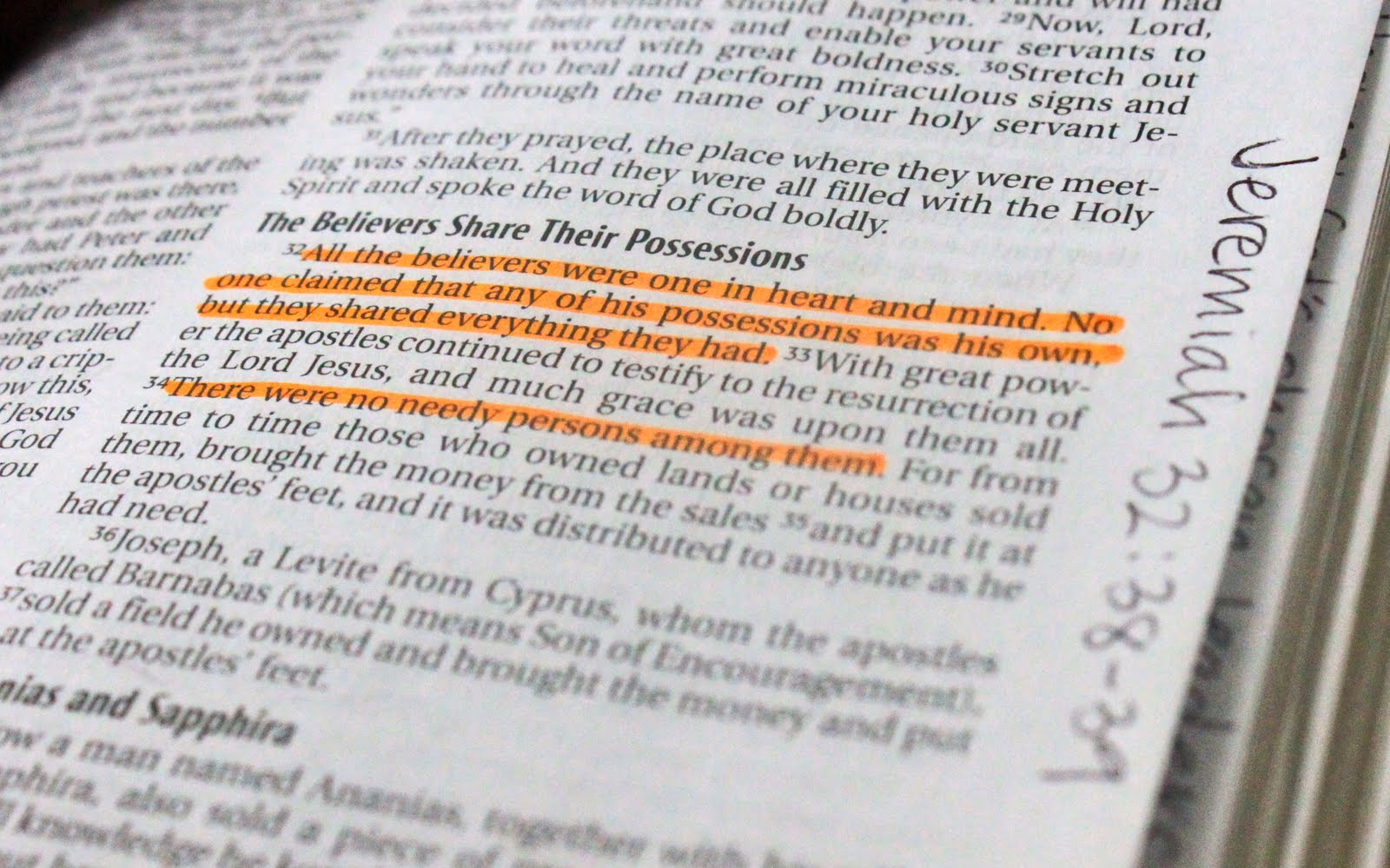
This week, Jason talked about the concept of the church being "one in heart and mind" as mentioned in Acts 4:32. This section of Acts describes how the people in the early church shared everything they had. Everything. No one among them needed anything because the church took care of its people. Unfortunately, I can't imagine sharing everything I have. I'm willing to share food, some of our money, open our house to weekend guests...but everything? Verse 36 mentions Joseph/Barnabas, who sold land that he owned and gave the money to the church. I assume it was all of the money from the sale so he was then without his land (which I assume means he was without his livelihood if he farmed) and without any money to save from the sale. That's sacrifice. 10% of our income, food, and occasional weekend guests doesn't seem like sacrifice in comparison to Joseph's sacrifice.

In Jeremiah 32:38-39, God says about the Israelites: "They will be my people, and I will be their God. I will give them singleness of heart and action, so that they will always fear me for their own good and the good of their children after them."  Jeremiah doesn't mention singleness in the context of sharing possessions, but when I look at the two passages together, I gather that sharing all of my possessions with my church family will be for my own good and for the good of my children. Maybe that's a stretch, but maybe its not. I think all Christians know that being generous is a good thing. And generosity comes back to bless us, as do most hard lessons we have to learn.

I'd heard the story from Acts about the believers sharing their possessions. I know I need to be more generous, but I'd never actually changed my habits after hearing the story. But now combined with the promise from God in Jeremiah, I feel more willing to change my habits because that promise is right there: this is for your own good, Ashley! While this lesson can be learned in the context of generosity, its absolutely applies to all areas of our life. If the church comes together to be "one in heart and mind", that unity will bless us and our children. I'm alright with that. :)

8.28.2011

Untitled, For Now*

I've realized that a blog can provide great accountability. If I share something with the world six readers, I'm more likely to do it. So I've decided that every Sunday, I'm going to share something I took away from church that morning. My hope is that by sharing what I learn, I'll be more intentional about remembering the lesson. What I take away may relate to the sermon or may not. Today, it doesn't really relate. 

*I need help with a title for this series of Sunday posts. Everything I come up with is cheesy. Suggestions welcomed-- no, needed.


We studied Acts 3 this morning and Jason talked about being refreshed by the Lord. The context: Peter and John are asked by a crippled beggar for money. Peter tells the beggar he has no money, but he commands the beggar to walk in Jesus Christ's name. The people watching were amazed by the miracle and came running to Peter, who rebukes them.

What stuck out to me was verses 12 & 13: "Men of Israel, why does this surprise you? Why do you stare at us as if by our own power or godliness we had made this man walk? The God of Abraham, Isaac and Jacob, the God of our fathers, has glorified his servant Jesus..."

Jason explained why Peter mentioned this name of God and the significance of that name to the Jews. 'The God of Abraham, Isaac and Jacob' would make the Jews remember Moses' encounter with the burning bush, when God identifies himself to Moses as (you guessed it) "...the God of your father, the God of Abraham, the God of Isaac and the God of Jacob". (Exodus 3:6)

By mentioning this particular name of God, Peter is telling the Jews to look past the miracle to the One who is behind the miracle. Look past the burning bush to the God who can create a fire that doesn't consume the bush. Look past the healed cripple to the God who can heal all diseases. God is all-powerful, and we can't forget that.